Les pièges du passé
With the flair for sizzling romantic suspense that has made her books international bestsellers, Elizabeth Adler, whose work has been hailed
by critics as "mesmerizing" Internet Bookwatch, "exhilarating" Publishers Weekly, and "sensuous" Kirkus Reviews,is
at the top of her form with her latest novel, All or Nothing.
Lithe, leggy attorney and law professor Marla Cwitowitz is dying for some excitement in her life--that is, other than being the girlfriend
of Al Giraud, private detective, sexy soul mate, and all-around best friend. So when she sees the potential for a crime-solving spree, she
jumps at the chance to moonlight as a detective. According to the evening news, local real estate agent Laurie Martin is missing and
presumed dead. Marla and Al happened to have seen her dining with an attractive man several days before her disappearance. The man is Steve
Mallard, loyal husband, doting father, and prime suspect. But Marla senses that something is not quite right. And her intuition has never
let her down. Believing that there's more to the story than meets the eye, she takes matters into her own hands, vowing to get to the bottom
of what's beginning to look like a very complex case. Al wants Marla to stay out of the way, fearing for her safety. He knows what's
involved in detective work, and he's not sure she can hold her own as an investigator. But she won't be warned off this case. Their
relationship has never been more fraught with complications--or sexual sizzle. With little warning or preparation, the two find themselves
crisscrossing the United States in frantic pursuit of a remorseless criminal in an effort to prove Mallard's innocence. Finally Marla's
found the excitement she's been looking for. With her, it's always been all or nothing
La fille prodigue
With a will of steel, Polish immigrant Florentyna Rosnovski is indeed Abel's daughter. She shares with her father a love of America, his
ideals, and his dream for the future. But she wants more to be the first female president.
Golden boy Richard Kane was born into a life of luxury. The scion of a banking magnate he is successful, handsome, and determined to carve
his own path in the world-and to
build a future with the woman he loves.
With Florentyna's ultimate goal only a heartbeat away, both are about to discover the shattering price of power as a titanic battle of
betrayal and deception reaches out from the past-a blood feud between two generations that threatens to destroy everything Florentyna and
Richard have fought to achieve.
Fils unique
Jean-Jacques Rousseau mentions his older brother François only two times in his classic Confessions. In The Only Son, Stéphane
Audeguy resurrects Rousseau's forgotten brother in a picaresque tale that brings to life the secret world of eighteenth-century Paris.
Instructed at an early age in the philosophy of libertinage by a decadent aristocrat and later apprenticed to a clock maker, François is
ultimately disowned by his family and flees to Paris's underworld. There he finds work in a brothel that caters to politicians and clergy
and begins his personal study of the varieties of sexual desire—to its most arcane proclivities. Audeguy uses the libertine's progress to
explore the interplay between the individual and society, much in the tradition of Jean-Jacques, but with a very different emphasis. Bold,
erotic, and historically fascinating, The Only Son is, in many ways, the anti-Confessions—François' own, decidedly
different, portrait of human nature
Albert Savarus
Written in 1842, Albert Savarus is a work of a circumstance at the same time a personal testimony. In correspondence since 1832,
lovers in 1834, Balzac and Madame Hanska were promised to be married. But the death of the old is Mr. Hanski was waiting.
The story which parodies and depicts French society in the period of the Restoration and the July Monarchy (1815–1848).
Captive
It's 1843, and Grace Marks has been convicted for her involvement in the vicious murders of her employer and his housekeeper and mistress.
Some believe Grace is innocent; others think her evil or insane. Now serving a life sentence, Grace claims to have no memory of the murders.
An up-and-coming expert in the burgeoning field of mental illness is engaged by a group of reformers and spiritualists who seek a pardon for
Grace. He listens to her story while bringing her closer and closer to the day she cannot remember. What will he find in attempting to
unlock her memories?
Captivating and disturbing, Alias Grace showcases best-selling, Booker Prize-winning author Margaret Atwood at the peak of her
powers
La musique du hasard
In a Pennsylvania meadow, a young fireman and an angry gambler are forced to build a wall of fifteenth-century stone. For Jim Nashe, it all started when he came into a small inheritance and left Boston in pusuit of "a life of freedom." Careening back and forth across the United States, waiting for the money to run out, Nashe met Jack Pozzi, a young man with a temper and a plan. With Nashe's last funds, they entered a poker game against two rich eccentrics, "risking everything on the single turn of a card." In Paul Auster's world of fiendish bargains and punitive whims, where chance is a shifting and powerful force, there is redemption, nonetheless, in Nashe's resolute quest for justice and his capacity for love
L'invention de la solitude
In this debut work by New York Times-bestselling author Paul Auster (The New York Trilogy), The Invention of Solitude, a memoir, established Auster’s reputation as a major new voice in American writing. His moving and personal meditation on fatherhood is split into two stylistically separate sections. In the first, Auster reflects on the memories of his father who was a distant, undemonstrative, and cold man who died an untimely death. As he sifts through his Father’s things, Auster uncovers a sixty-year-old murder mystery that sheds light on his father’s elusive character. In the second section, the perspective shifts and Auster begins to reflect on his own identity as a father by adopting the voice of a narrator, “A.” Through a mosaic of images, coincidences, and associations “A,” contemplates his separation from his son, his dying grandfather, turning the story into a self-conscious reflection on the process of writing.
L'étrange destin de Wangrin
Wangrin is a rogue and an operator, hustling both the colonial French and his own people. He is funny, outrageous, corrupt, traditional, and
memorable. Ba's book bridges the chasm between oral and written literature. The stories about Wangrin are drawn from oral sources, but in
the hands of this gifted writer these materials become transformed through the power of artistic imagination and license.
The Fortunes of Wangrin is a classic in Franchophone African literature.
Le père Goriot
Le Pere Goriot, Old Goriot or Father Goriot is an 1835 novel by French novelist and playwright Honore de Balzac (1799-1850), included in the Scenes de la vie privee section of his novel sequence La Comedie humaine. The novel takes place during the Bourbon Restoration, which brought profound changes to French society; the struggle by individuals to secure a higher social status is a major theme in the book. The city of Paris also impresses itself on the characters - especially young Rastignac, who grew up in the provinces of southern France. Balzac analyzes, through Goriot and others, the nature of family and marriage, providing a pessimistic view of these institutions.
Les chouans
Les Chouans (French pronunciation: [le ʃwɑ̃], The Chouans) is an 1829 novel by French novelist and playwright Honoré de Balzac (1799–1850) and included in the Scènes de la vie militaire section of his novel sequence La Comédie humaine. Set in the French region of Brittany, the novel combines military history with a love story between the aristocratic Marie de Verneuil and the Chouan royalist Alphonse de Montauran. It takes place during the 1799 post-war uprising in Fougères.
Le cabinet des antiques
The plot is partially narrated by journalist and author, Emile Blondet. The narrator talks about events he has witnessed, mainly his admiration for Armande d'Esgrignon and a small provincial town where his father, the respectable judge Blondet, still lives.
As a child, Blondet frequently watches Armande while she takes a stroll with her nephew, Victurien d'Esgrigon. The angel-faced child is carefully taken care of, as he doesn't have a mother. He was raised by his doting aunt and his adoring father. As a young man, Victurien is strikingly intelligent but has a habit of lying, he prompts his impoverished family to give him more than they can afford to. Chesnel, the old notary, always manages to clear their debts, eventually ruining himself for Victurien. He even gives the young man his savings when the latter is sent to Paris.
However, becoming a part of the marquis of Esgrigon's circle is a privilege, as only noble families are admitted. This makes some upstarts, such as Du Croisier, vengeful. The latter notices Victurien's penchants and manages to fault him. Victurien ends up being arrested for owing Du Croisier colossal sums of money. Chesnel manages to get the young man out of trouble with one of his clever ploys.
Victurien eventually marries Du Croisier's niece, wallowing in her vast wealth and regularly making her unhappy.
César Birotteau
Honore de Balzac lived most of his life one step from his creditors; his house in Paris even had a special exit for avoiding them. No one
knew more about money problems than Balzac, & this is his subject in Rise and Fall of Cesar Birotteau--one of Balzac's greatest
novels.
It's the story of Cesar Birotteau, an honest perfumer who's lured into overextending himself. This luring is the work of the unsavory du
Tillet, an employee Birotteau fired for embezzlement. The Embezzler works in secret to take revenge. Take it he does: Birotteau falls hard.
But all is not lost--not yet. Anselme Popinot, a brilliant young marketer in love with Birotteau's daughter, works to help Birotteau
recover. Perhaps together they can recover Birotteau's honor. Perhaps
Eugénie Grandet
"Who is going to marry Eugenie Grandet?"
This is the question that fills the minds of the inhabitants of Saumur, the setting for Eugenie Grandet (1833), one of the earliest
and most famous novels in Balzac's Comedie humaine. The Grandet household, oppressed by the exacting miserliness of Grandet himself, is

jerked violently out of routine by the sudden arrival of Eugenie's cousin Charles, recently orphaned and penniless. Eugenie's emotional
awakening, stimulated by her love for her cousin, brings her into direct conflict with her father, whose cunning and financial success are
matched against her determination to rebel.
Eugenie's moving story is set against the backdrop of provincial oppression, the vicissitudes of the wine trade, and the workings of the
financial system in the aftermath of the French Revolution. It is both a poignant portrayal of private life and a vigorous fictional
document of its age.
Le curé de Tours
Pierrette
The Abbé François Birotteau and the Abbé Hyacinthe Troubert, both of whom are priests at Tours, have separate lodgings in the house belonging to the crabby spinster Sophie Gamard in that city. Birotteau is an other-worldly, gentle, introspective type; Troubert, who is ten years younger than his fellow boarder, is very much of the world: he is a careerist devoured by ambition.
Birotteau prides himself on his furniture and fine library, inherited from his friend and predecessor as parish priest of Saint-Gatien de Tours. Without reading all its clauses, or at least without remembering them, he signs a document handed to him by Mlle Gamard, forfeiting his entitlement to his lodgings and making over their contents to her in the event of his vacating his premises for any considerable period. He leaves them for a fortnight's stay in the country, where he is served with a possession order by his landlady's lawyer. On returning home he finds Troubert installed in his apartments, in full possession of his furniture and his library, whilst he himself has been moved into inferior rooms.
Birotteau abandons any prospect of a lawsuit to regain his property, as his friends in the provincial aristocracy of Tours gradually withdraw their backing. In return for giving up his rooms he had expected to be appointed to the vacant canonry of the cathedral. Instead, he is demoted to a much poorer parish two or three miles out of Tours. Deprived of his library and furniture, he leaves Mlle Gamard's, thinking that this will indirectly bring him, through Troubert, the canonry which never comes. Troubert, on the other hand, is first appointed Vicar-General of the diocese of Tours, then Bishop of Troyes, scarcely deigning to look in Birotteau's direction as he speeds past his colleague's dilapidated presbytery on his way to his diocese.
La mort du petit cheval
A brilliant analysis of how to survive ghastly parents without becoming one oneself!
Au nom du fils

Le sang des autres
Jean Blomart, patriot leader against the German forces of occupation, waits throughout an endless night for his lover, Helene, to die. He is the one who sent her on the mission that led to her death, and before morning, he must ultimately decide how many others to send to a similar fate.
L'invitée
She Came to Stay (French, L'Invitée) is a novel written by French author Simone de Beauvoir first published in 1943. The novel is a fictional account of her and Jean-Paul Sartre's relationship with Olga Kosakiewicz and Wanda Kosakiewicz. Set in Paris on the eve of and during World War II, the novel revolves around Françoise, whose open relationship with her partner Pierre becomes strained when they form a ménage à trois with her younger friend Xaviere. The novel explores many existentialist concepts such as freedom, angst, and the other.
La cousine Bette
Poor, plain spinster Bette is compelled to survive on the condescending patronage of her socially superior relatives in Paris: her
beautiful, saintly cousin Adeline, the philandering Baron Hulot and their daughter Hortense. Already deeply resentful of their wealth, when
Bette learns that the man she is in love with plans to marry Hortense, she becomes consumed by the desire to exact her revenge and dedicates
herself to the destruction of the Hulot family, plotting their ruin with patient, silent malice.
Cousin Bette is a gripping tale of violent jealousy, sexual passion and treachery, and a brilliant portrayal of the grasping,
bourgeois society of 1840s Paris. The culmination of the Comedie humaine, Balzac's epic chronicle of his times, it is one of his greatest
triumphs as a novelist.
Une gourmandise
n the heart of Paris, in the posh building made famous in The Elegance of the Hedgehog, Pierre Athens, the greatest food critic in
the world, is dying. Revered by some and reviled by many, Monsieur Arthens has been lording it over the world’s most esteemed chefs for
years, passing judgment on their creations, deciding their fates with a stroke of his pen, destroying and building reputations on a whim.
But now, during these his final hours, his mind has turned to simpler things. He is desperately searching for that singular flavor, that
sublime something once sampled, never forgotten, the Flavor par excellence. Indeed, this flamboyant and self-absorbed man desires
only one thing before he dies: one last taste.
Thus begins a charming voyage that traces the career of Monsieur Arthens from childhood to maturity across a celebration of all manner of
culinary delights. Alternating with the voice of the supercilious Arthens is a chorus belonging to his acquaintances and
familiars—relatives, lovers, a would-be protege, even a cat. Each will have his or her say about M. Arthens, a man who has inspired only
extreme emotions in people. Here, as in The Elegance of Hedgehog, Muriel Barbery’s story celebrates life’s simple pleasures and
sublime moments while condemning the arrogance and vulgarity of power.
L'élégance du hérisson
A moving, funny, triumphant novel that exalts the quiet victories of the inconspicuous among us.
We are in the center of Paris, in an elegant apartment building inhabited by bourgeois families. Renée, the concierge, is witness to the
lavish but vacuous lives of her numerous employers. Outwardly she conforms to every stereotype of the concierge: fat, cantankerous, addicted
to television. Yet, unbeknownst to her employers, Renée is a cultured autodidact who adores art, philosophy, music, and Japanese culture.
With humor and intelligence she scrutinizes the lives of the building's tenants, who for their part are barely aware of her existence.
Then there's Paloma, a twelve-year-old genius. She is the daughter of a tedious parliamentarian, a talented and startlingly lucid child who
has decided to end her life on the sixteenth of June, her thirteenth birthday. Until then she will continue behaving as everyone expects her
to behave: a mediocre pre-teen high on adolescent subculture, a good but not an outstanding student, an obedient if obstinate daughter.
Paloma and Renée hide both their true talents and their finest qualities from a world they suspect cannot or will not appreciate them. They
discover their kindred souls when a wealthy Japanese man named Ozu arrives in the building. Only he is able to gain Paloma's trust and to
see through Renée's timeworn disguise to the secret that haunts her. This is a moving, funny, triumphant novel that exalts the quiet
victories of the inconspicuous among us
Le grand secret
a story about a woman looking for the man she loves, who seemed to have been kidnaped. While searching she will "come across" something
huge, the world's best kept secret, an info shared only by our political leaders. A secret that could change the world.
It's a sci-fi story who bases itself on history, but then uses some events to create a new story, where world leaders are conspiring, but
this time for the greater good.
It was captivating. The plot is good, and we don't really have clue of what's really at stakes until it's actually explained to us
L'amour dure trois ans
Marc Marronier comes of age whilst exploring his professed belief that 'love lasts only three years'. Despite the wit – the author’s trademark is wrong-footing humour - this is not an easy read. But make up your mind to enjoy the constant changes in style (including the two pages without full stops, let alone paragraphs) and just go with the flow. I guarantee you'll find Marc's surprising metamorphosis well worth any effort.
Béni ou le Paradis Privé
The protagonist / narrator Ben Abdallah, who prefers to be called Béni, is an overweight adolescent who, though he is doing well at school, is engaged in a daily struggle to find his place in French society
L'enfant bleu
L’enfant Bleu, The Blue Child is an absolutely beautiful book. So gentle and accepting in tone, it succeeds, in a very unassuming
way, in providing a transformative experience for the reader and the two main characters—the narrator Véronique, analyst and teacher, who
follows Orion, a teenage boy suffering from violent outbursts and delusional thinking. Through drawing and painting, mediated by the
analyst, Orion will slowly access his own healing imagination. This process will finally lead to the emergence of the subjective “I” by
making his mark as a true artist.
This inspiring account, told in spare, poetic language, is based on the clinical case of Lionel D, a therapeutic process that took place
over the course of more than a decade in real life
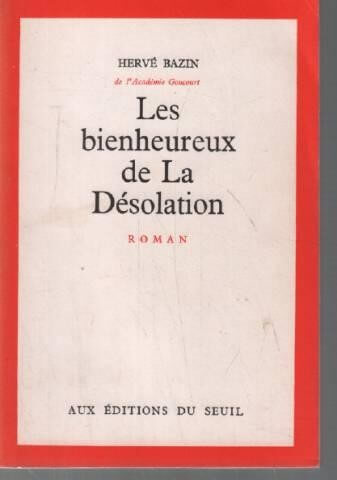
Les bienheureux de La Désolation
It is the real story of a small community that has to fight with winds, with the ocean, with the lack of the gardens. The people of Tristan
da Cunha is learning us, after almost 50 years, the lesson of the family, the victory of the friendhip aver the competition, the acceptance
of the modern life in a special way that includes to care about old relatives, the refuse to know words like envy or greeding.
I learned this book many times; it is not litterature, I would say, it is writed more like a suite of columns in a journal paper. It is
simple and true.
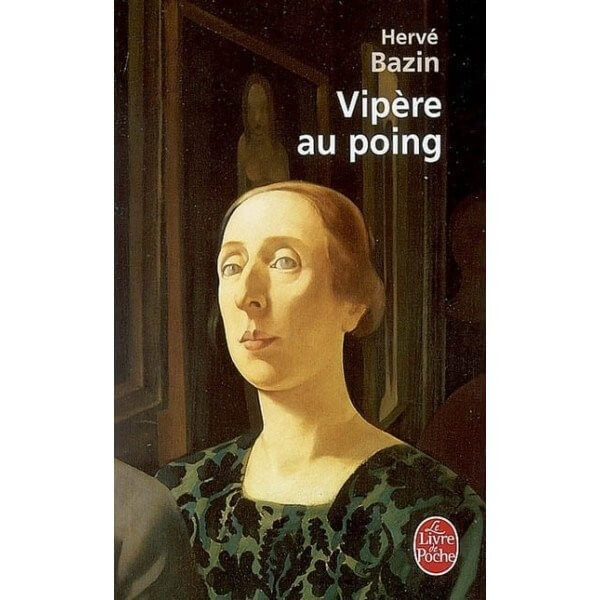
Vipère au poing
Although written in a comic note, the book reveals the opressed childhood of Jean, under the dictatorship of his mother. Three boys allied
against their mother, this is something relevant for how mean the mother was. The parts act like in a real war, building plans and
punishments to defeat the enemy. Unfortunately, Herve Bazin used memories from his own childhood when he wrote this book, most of it is a
real story.
In the same time, besides his mother Jean mocks the French burgeoisie represented by his parents and relatives. After more than ten years
spent with their mother (from 6 to 16 yrs old), the boys succeeded in their escape plan and left home for highschool
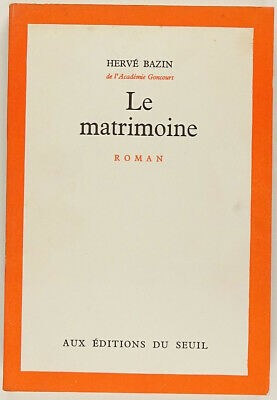
Le matrimoine
This book often makes readers have mixed feelings. On the one hand we see the life of a typical bourgeois family of the last century,
described very realistic, the eyes men for the wedding, life together, the arrival of children, etc.
Such a view in the literature is not typical because usually the relations between the sexes – the sphere of the possession of the writers.
This interest in the book.
On the other hand, Hervé Bazin describes everything is so realistic that at times it becomes uncomfortable. In this case, I note, I read all
kinds of books, say, Henry Miller, who did not skimp on realism in the description of relations and the description of sexual life. But I
have never experienced.
When reading Bazin, there is an uneasy feeling, the same one as written Strugatsky, which makes Prim toes. Feel like spying on people
through the glass, and they do not know